
We’re going to regret embracing Chinese ‘green’ tech
| By Dan McTeagueThis article originally appeared in the Western Standard.
After years of rolling out the welcome mat, the European Union is finally waking up to the downsides of attempting to build a Net-Zero economy on the back of heavily subsidized Chinese imports. While Brussels had previously envisioned Chinese Electric Vehicles supplementing their native variety, enabling them to achieve a totally electric fleet in the near future, they were forced to impose anti-dumping tariffs of as much as 45.3% in 2024.
Even so, Chinese vehicle exports have continued their upward trajectory. Tariffs or not, China keeps finding the door.
Now Europe is waking up to the security dimension too. This week, the EU announced it will block funding for solar energy projects using key Chinese components – specifically inverters – starting November 1st. The reason? EU officials have confirmed that imported inverters can be used to manipulate electricity production, gain unauthorized access to operational data, and in a worst-case scenario, trigger countrywide blackouts.
This is not merely a trade dispute. It is a recognition that building critical energy infrastructure on Chinese technology creates a vulnerability that no tariff can fix.
Canada, meanwhile, is doing the opposite.
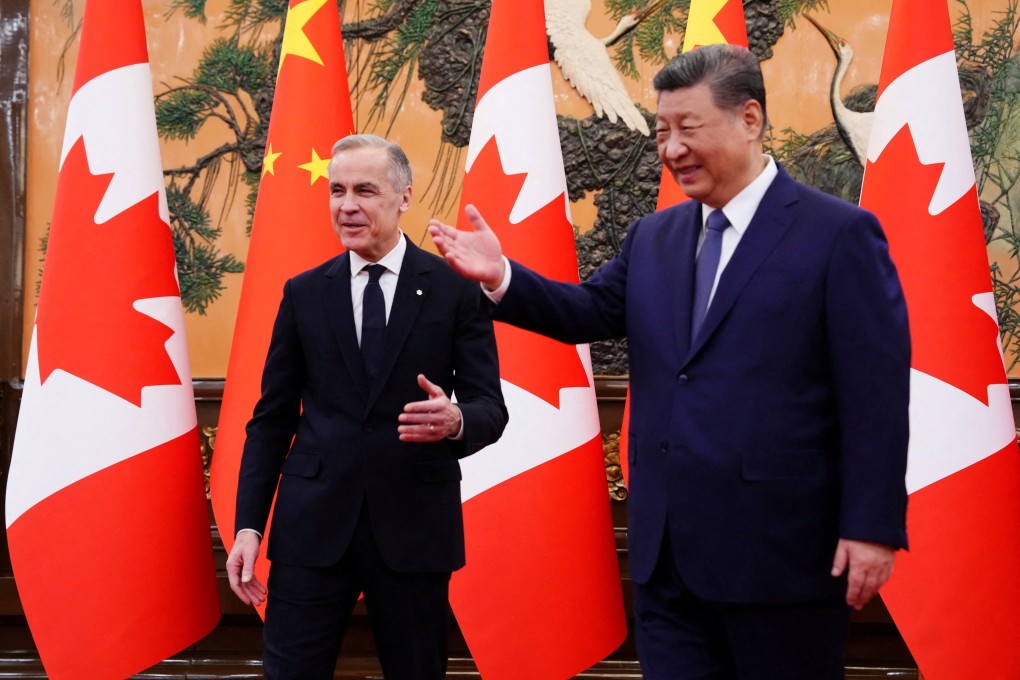
In January, Prime Minister Mark Carney flew to Beijing and came away with a deal that slashed our 100% tariff on Chinese EVs to just 6.1%, opening the door to 49,000 Chinese vehicles this year, a number which will grow yearly thereafter until at least 2030. In exchange, China agreed to lower its tariff on canola seed and lift retaliatory measures on other agricultural products, at least for the time being.
Now, this is being sold as necessary economic diversification in the face of the uncertainty of the CUSMA renegotiations. In reality, this is the prime minister doubling down on anti-Americanism for his own political benefit.
Remember, Canada imposed the original 100% EV tariff in 2024 for the same reason the U.S. did – because subsidized Chinese vehicles were undercutting North American manufacturers. Carney has now abandoned that logic, not because the Chinese subsidies went away, but because it gives him a way to differentiate himself from Washington.
Cutting off our nose to spite our face has rarely been this explicit.
And the costs are real. Carney’s new EV emissions standards – his attempted rebrand of the Trudeau EV mandate – will continue pushing automakers to manufacture vehicles Canadians don’t particularly want, and which are impractical in our climate, and across our country’s vast distances. Worse, they will force Canadian firms to compete against Chinese automakers who benefit from massive government subsidies and far weaker labour, environmental, and humanitarian standards.
The security risks are no less serious. EVs are sophisticated data-collection platforms. Who owns that data, and the extent to which firms can sell it to third parties, is controversial even with domestically produced vehicles.
Under China’s national security laws, any data gathered by a Chinese company – location, camera feeds, microphone recordings, driving patterns – can be requested by the governing Communist Party. The U.S. has been imposing new regulations with an eye towards banning Chinese software in vehicles for exactly this reason. The same logic that led Europe to restrict Chinese solar inverters applies here. These aren’t just cars. They’re connected devices, in Canadian driveways, feeding data to a state that has already demonstrated it will exploit every technological foothold it gets.
And then there is the damage to our most important relationship. The U.S. Ambassador to Canada, Pete Hoekstra, has made Washington’s position crystal clear. “Those cars can come in from China, come into Canada,” he said, “but they’re not going to cross the border into the U.S. That ain’t gonna happen.” The U.S. is just not prepared to accept the national security risks, regardless of what Canada decides to do.
The consequences for the deeply integrated North American auto sector could be severe. For decades, vehicles and parts have crossed the U.S.-Canada border in both directions as a matter of routine. That integration is now under threat. Canada has agreed to annually import tens of thousands of vehicles that the U.S. has formally barred from its market on security grounds and that will be ineligible for re-export south of the border.
To make matters worse, the USMCA is up for its mandatory review this summer, and Canada’s divergence from U.S. policy on China has become a live issue in those negotiations. Carney has called China “more predictable” than the United States. That framing should alarm every Canadian. The U.S. is our closest ally and trading partner, the destination for more than 70% of our exports.
On the other hand, China is a strategic competitor that has demonstrated, repeatedly, that it views economic leverage as a political weapon. And yet, with our EV policies that’s exactly what we’re giving it.
Europe is now painfully trying to untangle itself from its own manufactured dependency on Chinese green technology. Canada appears determined to make the same mistake, not by accident, but by design, and with enthusiasm.
If there’s any sense left in Ottawa – and I’m doubtful – the government should cancel the China EV deal, align with our North American partners on connected vehicle security, and stop pretending that economic dependence on Beijing is a form of independence from Washington. It is neither. It is a gamble with Canada’s industrial base, its national security, and its most vital alliance. And it won’t end well.
Recent Posts
-
WATCH: Demand for diesel is 'extraordinarily alarming'
September 16, 2026 -
WATCH: How the rising price of diesel affects all of us
September 9, 2026 -
Suspending the gas tax won’t fix Canada’s fuel price crisis
September 8, 2026 -
Extending Fuel Tax Holiday is "Pure Window-Dressing,” Says McTeague.
September 2, 2026 -
WATCH: The Liberal EV mandate is here to stay
September 1, 2026