
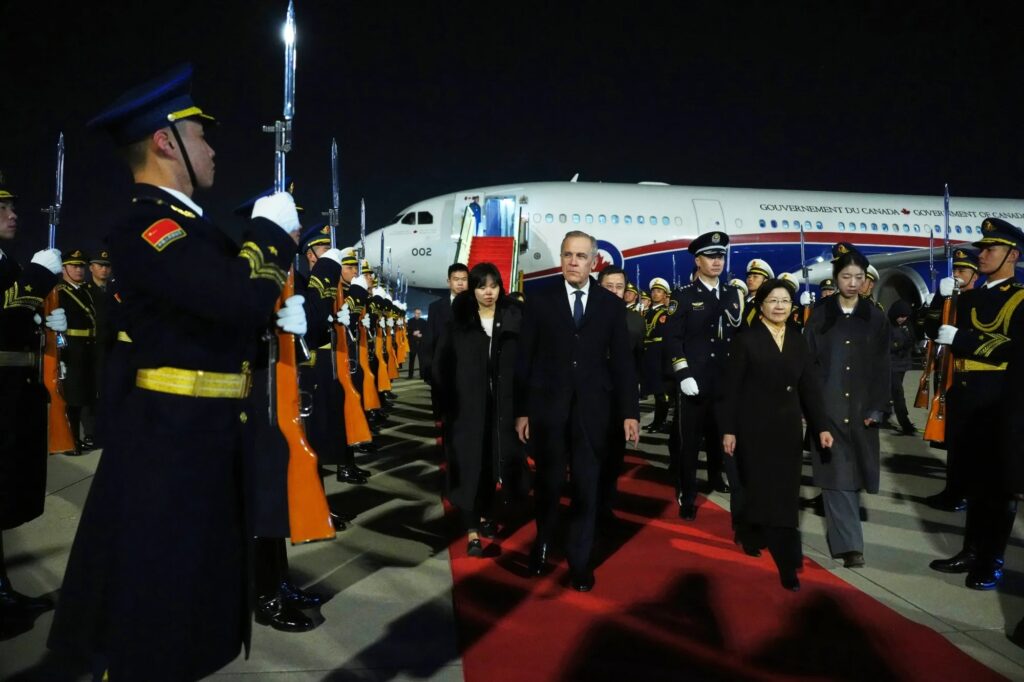
MCTEAGUE: Hat in hand to Beijing — why Carney’s China trip should alarm Canadians
| By Dan McTeagueThis column originally appeared in the Western Standard.
I must say, Mark Carney’s trip to China is giving me a case of the heebie-jeebies.
Yes, I understand that China is the second-largest economy in the world, and that, because of their (unfortunate, in my view) admission into the WTO a quarter of a century ago, they are highly integrated into the global economy.
No matter what, we are going to do business with them.
And though it makes me uncomfortable, knowing a bit about the human rights abuses engaged in by China’s repressive Communist government — “Google Uyghurs,” to quote the signs that will get you tossed from an NBA game — I accept that that business can and will benefit our two countries.
But what makes me extremely worried is the hat-in-hand posture of the prime minister, as he visits a geopolitical adversary, desperate for a win.
Especially because reports suggest that the “carrot” the prime minister is dangling is the abolition of our 100% tariff on Chinese-made Electric Vehicles (EVs) in exchange for lifting their retaliatory tariffs on Canadian canola — which has hurt Canadian farmers — along with a grab bag of other products. Apparently, this would be part of a larger deal to get China to buy more Canadian oil.
In my view, lifting the tariff on Chinese EVs would be to sell out Canada’s already-faltering automotive industry.
Remember that that tariff was instituted to protect ourselves from China taking advantage of our EV mandate by dumping their vehicles into our country, at much lower prices than Canadian companies can charge.
Even with the more than $52 billion in taxpayer dollars we’ve earmarked to make Canada an EV hub, China’s massive state support, along with their significantly lower labour and environmental standards, would enable their manufacturers to undercut our prices, at least until our firms go out of business.
Though enforcement of the mandate has been postponed by one year, our automakers are still suffering under it, facing the threat of fines if they don’t sell enough EVs, and expected to supply a 100% national EV fleet across the nation in under a decade, despite the fact that fewer and fewer Canadians actually want to buy them.
And on top of that, we’re proposing to subject them to competition from China? That would be a disaster, perhaps ending the Canadian automotive industry as a whole — as in, not just the EV portion of it — and tossing the more than one hundred thousand Canadians who work in the industry out of work.
I’m on record as saying that the way to address this particular trade dispute with China is to scrap the EV mandate altogether. It would make us less of a target for China’s policy of exploiting Western environmentalist sentiment, while also saving taxpayer dollars on subsidies and, most importantly, freeing Canadians to purchase vehicles which they actually want, and which satisfy their needs.
That said, there is a right way to strike a deal with China, one that doesn’t reek of desperation, while creating jobs and being a boon for our economy. With their access to Venezuelan oil drying up, they’re starving for a product that we are well situated to supply. Working out a deal to ship more of our crude their way would be a smart play.
(And if they balk at paying $8-$10 more per barrel than they were paying Venezuela? Tough. The discount they got for doing business with a pariah state doesn’t carry over.)
But we’ve got to go into this with our eyes wide open. China’s no pushover. And if our current trade dispute hasn’t taught us that, the National Post’s Tristin Hopper has been kind enough to compile a list of times that China has used its trade policy to settle geopolitical scores just in the past few years — from threatening “ruinous tariffs” against Australia, and banning their beef, after then-prime minister Scott Morrison called for an inquiry into the origin of Covid-19, to cutting off imports of Norwegian salmon in retaliation for Chinese dissident Liu Xiaobo winning the Nobel Peace Prize.
Suffice it to say, increased exposure to Chinese markets carries with it as many risks as rewards. And that is something that the right prime minister, one willing to play hardball, might be able to manage.
But a prime minister who would, for instance, order members of his own party to leave Taiwan so as not to upset Chairman Xi during his visit? That remains to be seen.
In the end, this whole jaunt feels like a crap shoot for Carney, as he does his best to live up to that deal-maker businessman image he peddled so hard on the campaign trail.
He clearly wants to send the “elbowzoos”-approved message to Donald Trump that Canada doesn’t need America’s business, that there are other markets which will enable us to leave our southern neighbor in the dust.
But that’s dead wrong, and I hope Carney knows it. America is our biggest trading partner, and that’ll be true next year, next decade, and next century. Our proximity, and our cultural and historical ties make that an absolute certainty.
That’s something we’ve got to learn to live with. And Carney’s desperation to go a different route — even giving the store away to Beijing — feels like playing with fire.
Recent Posts
-
WATCH: Chinese EVs have no place in Canada
February 26, 2026 -
WATCH: Focus on energy, not impossible net-zero goals
February 24, 2026 -
WATCH: Thinking about buying a Chinese EV? Think again.
February 22, 2026 -
WATCH: Are Chinese EVs driving into Canada’s national security blind spot?
February 19, 2026 -
Doug Ford’s net-zero fantasy costs Ontarians billions in electricity subsidies
February 12, 2026