
Carney’s pipeline permission slip doesn’t address our deeper problems
| By Dan McTeagueThis article originally appeared in the Western Standard
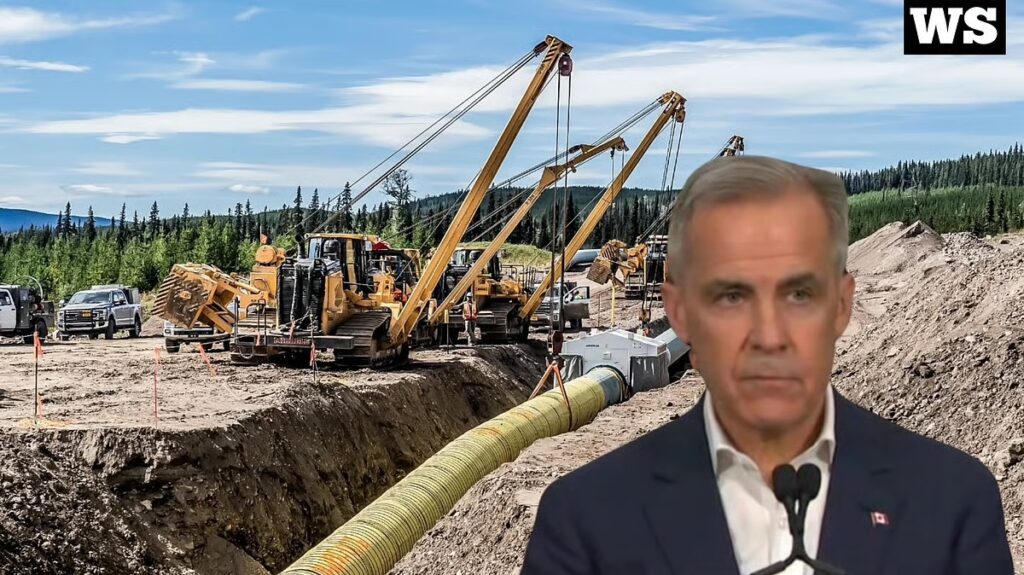
There was a striking story which was buried in the news cycle in Canada by reports of the new Carney-Smith Memorandum of Understanding. While Canadians were being told to celebrate an agreement that might — might — allow a pipeline to begin construction in the fall of 2027, the United Arab Emirates announced plans for a new pipeline that will be fully operational around the same time.
Let that land for a moment. A desert nation with roughly a quarter of our GDP is completing pipeline infrastructure on a timeline that Canada can only hope to begin breaking ground on.
More impressive still, the UAE is responding to an urgent need to make sure Iran is no longer allowed to hobble their economy by shutting down the Strait of Hormuz. Good for them! But will contemporary Canada ever respond to an urgent need with actual urgency? The next time will be the first time.
If you want a single image that captures just how far we have fallen, that is it.
I have been writing about this MOU since its original form emerged last November, and my concerns then are my concerns now, with a fresh coat of paint.
The deal, as originally laid out, committed Alberta to a carbon tax hike, recommitted both governments to net zero, and pledged tens of billions in taxpayer dollars toward a Carbon Capture and Storage boondoggle that will produce negligible emissions reductions while lining the pockets of well-connected green firms.
In exchange, Alberta might — might — get a pipeline. There were no real certainties. Just a handshake and a smile from the Prime Minister, which could be reversed on a whim.
As I noted at the time, this is no way to attract investment. Major infrastructure cannot be erected on the foundation of backroom deals between politicians. What investors need is a predictable, transparent regulatory regime, not a one-time exemption from C-69, the No More Pipelines Act.
And what is to be done about Bill C-48, the Oil Tanker Moratorium Act, which would make this pipeline dead in the water? No word as of yet.
Let’s be clear about what this deal actually contains. On the oil and gas side, the MOU is conspicuously thin. What it is not thin on is the list of conditions Alberta must satisfy to earn Ottawa’s permission to develop its own resources: a carbon tax being hiked to $130 per tonne by 2040, a commitment to a carbon capture project that will cost tens of billions, methane regulations, emissions intensity targets, First Nations consultations still to be worked out, and a net zero by 2050 pledge.
Premier Smith has touted the lower carbon rate — $130 instead of $170 per tonne — as saving industry some $250 billion in compliance costs. But the industry itself isn’t singing the same tune. The Oil Sands Alliance, whose members actually have to operate under this regime, were blunt in their response: this carbon tax only adds uncompetitive costs on top of the costs of a carbon capture project. No other major oil-producing nation in the world faces anything like it. Not the Americans. Not the Saudis. Not the Russians. Nobody.
Of course, a $1.2 billion fund — of which Alberta taxpayers will be on the hook for $600 million — will be established to help cushion the blow of the tax hike. Which is to say that taxpayers will be hit three times over on this one — from the tax hike itself and from the federal and provincial tax dollars being used to hide its true cost.
Meanwhile, Ottawa has not approved or actively advanced the South Bow Prairie Connector pipeline, which would connect directly to the US Bridger pipeline approved by President Trump weeks ago. While Carney boasts about Canada becoming an “energy superpower” and approving projects “at speeds never seen before,” other ready-to-go pipeline projects remain stuck in bureaucratic limbo.
Really, the right time to build this pipeline was a decade ago. What we got instead was a decade of net zero nonsense masquerading as energy policy — blocked projects, capital driven south of the border, and a dollar quietly hollowed out so that every global price spike hits Canadians much harder than the headline number suggests.
This past year saw the slowest annual growth Canada has recorded since the depths of the pandemic. That should surprise no one. Since 2015, we’ve been adding red tape and piling on anti-resource sector legislation. We told the energy industry to take their money elsewhere, and the world that we were closed for business. They listened.
Now we are in a genuine crisis — gas prices through the roof, the cost of living right along with it, and our economy groaning. This is the response. A single pipeline permission slip, with unreasonable conditions attached, signed with great ceremony, which addresses none of our deeper problems.
Canada has given the farm away for a few magic green beans. The clock is ticking. Our window to act, to set things right, is narrower than our leaders seem to understand. Here’s hoping that someone with the power to do something wakes up to that reality, and soon.
Recent Posts
-
WATCH: What the G7 releasing emergency could energy mean for the price at the pumps
October 7, 2026 -
WATCH: The Liberal's Hidden Fuel Tax Is Driving Up The Price on EVERYTHING!
September 30, 2026 -
WATCH: Record Diesel Prices Show Why Canada Needs More Pipelines
September 23, 2026 -
WATCH: Demand for diesel is 'extraordinarily alarming'
September 16, 2026 -
WATCH: How the rising price of diesel affects all of us
September 9, 2026
